Bitcoin's 23% Week: Bonds Lit the Fuse, ETF Flows Carried It

Bitcoin opened Monday at $62,900 and touched $79,500 on Friday, trading near $77,400 as I write — about 23% up on the week, which several outlets have reported as its biggest weekly gain since March 2023. Most of the coverage credits one thing: the U.S. Treasury doubling its long-dated bond buybacks.
That explanation is right about Wednesday and wrong about the rest of the week. The bond-market effect it describes had already reversed by Thursday — while Bitcoin kept climbing another 9%. Here's the full chain, including the part that broke.
(All Bitcoin prices below are Binance daily candles; venues differ by a few hundred dollars.)
Wednesday: The Announcement That Started It
On August 19, 2026, the U.S. Treasury published press release sb0607, raising the maximum size of its liquidity-support buyback operations for longer-dated government bonds — the 10-to-20-year and 20-to-30-year sectors — from $2 billion to at least $4 billion per operation, effective September 9 through November 4.
In plain language: the Treasury buys back existing long-dated bonds that have become hard to trade, funding it through regular new issuance. It's a plumbing operation aimed at the functioning of the Treasury market itself. The timing mattered — the announcement landed days after 30-year yields hit 5.337% on Tuesday, their highest level since 2007.
The bond market's first reaction was immediate:
- 10-year yield: −6 basis points, to 4.647%
- 30-year yield: −9 basis points, to about 5.19%
And the transmission to risk assets is textbook: when the return on the safest long-dated asset falls, everything riskier becomes relatively more attractive by comparison. Lower discount rate, higher price on assets valued off future expectations. Not crypto-specific — equities, credit, gold and Bitcoin all sit downstream of the same rate.
Bitcoin ran from a $64,166 low to $70,000, closing Wednesday at $69,335.
The Second Catalyst: Washington, Twice
The yield story wasn't operating alone. Crypto had its own news in the same 48 hours:
- Tuesday, August 18: the SEC proposed long-awaited rules exempting certain token offerings from securities registration — two registration exemptions for crypto investment contracts, disclosure requirements for issuers (financial statements and ongoing reporting for larger offerings), and an exit path out of securities classification once a project fulfills its core managerial commitments.
- Wednesday, August 19: President Trump hosted crypto executives at the White House — Coinbase, Ripple, Andreessen Horowitz, Nasdaq — alongside SEC Chair Paul Atkins and CFTC Chair Mike Selig, with crypto legislation still stalled in Congress.
Nobody can honestly split the move between these catalysts; anyone quoting you a percentage is making it up. Ether — the major most exposed to how token markets get regulated — jumped about 10% and reclaimed $2,000 for the first time since May, outrunning Bitcoin on the day. That's consistent with the regulatory story mattering, but I'd stop short of calling it evidence: ether is a higher-beta asset that routinely outruns Bitcoin on risk-on days, and it also carried the more crowded short book. Three explanations, one observation — you can't rank them from price alone.
The Amplifier: A Leveraged Short Squeeze
The catalysts explain direction. Leverage explains violence.
A large cohort of traders was positioned short into Wednesday. As price rose against them, exchanges issued margin calls; traders who couldn't post collateral had positions force-closed. A liquidated short is a forced buy. Forced buying lifts price, which triggers the next layer of margin calls, which forces more buying.
As reported from exchange liquidation trackers — which capture only reported liquidations and typically understate the true total — roughly $1.2 billion in positions were wiped out within a single hour, about $1.14 billion of them shorts. Over 24 hours, short liquidations reached approximately $1.57 billion across more than 114,000 traders.
Worth noting: ether led that cascade too, with around $457 million in short liquidations over four hours versus roughly $171 million for Bitcoin — consistent with it sitting at the intersection of both catalysts with crowded shorts on top.
Thursday: The Bond Story Broke
Here is the part almost nobody has updated their thread for.
The relief in long-end yields lasted exactly one session. On Thursday, the 30-year yield rose back to 5.273% — erasing most of the post-announcement drop, as investors decided that a few billion per operation doesn't offset large fiscal deficits, persistent inflation and heavy borrowing needs. CNBC's framing was blunt: Bessent's expanded buyback offered "only a one-day reprieve."
If the bond channel were the whole story, Bitcoin should have given back its gains in step.
It didn't. Bitcoin closed Thursday at $73,025, then ran to $79,500 on Friday — roughly 9% higher while the yield that supposedly caused the rally was moving the wrong way.
That's a falsified explanation, and it's worth saying plainly rather than quietly dropping it: the buyback lit the fuse, but it did not carry the week. Any framework that can't survive its own follow-through data isn't a framework — it's a headline.
What Actually Carried It
Two things took over once the yield impulse faded.
1. ETF flows — real money, not sentiment. U.S. spot Bitcoin ETFs pulled in $1.61 billion between August 17 and 20 (Farside Investors), four consecutive sessions of net inflows. Sector net assets reached $84.31 billion, now holding about 6.08% of circulating Bitcoin supply. This is the part that isn't a narrative: it's recorded, daily, per-fund creation activity that anyone can check.
Two honest caveats, though. That window starts on Monday — two days before the Treasury announcement — so the buying was already underway before the catalyst everyone credits; the flows weren't a response to it. And four sessions is a very short window. It tells you buyers kept showing up after the bond excuse expired. It does not tell you they'll show up next week.
2. Expectations of more intervention. Less than 24 hours after the initial announcement, Treasury Secretary Scott Bessent told CNBC: "We're going to increase the size of the buyback. I would note that it could be more than the $4 billion per issue."
Note what that second item actually is. The first upsized operation has not happened yet — it starts September 9. Nothing has been bought. The market is pricing an expectation of future policy, which is a far more fragile input than a completed flow, and it can be repriced by a single sentence in the other direction.
What This Was Not
This is not QE, and the Fed did not print money.
Quantitative easing is the Federal Reserve creating new reserves to buy securities, expanding its balance sheet and the money supply. That is not what happened here. The Treasury is buying back its own existing bonds, funded by issuing new ones — swapping one form of government debt for another. No net money is created. The Fed is not involved.
Scale matters too: a few billion per operation is a liquidity-management tool against a debt stock in the tens of trillions. Plumbing, not stimulus.
I'm being pedantic about this because the "money printer" reading is what turns a tradable week into an expensive belief. If you buy because you think a new monetary regime started, you will hold through the evidence that it didn't — and this week already produced that evidence on Thursday.
What I'm Watching
- September 9. The first upsized operation actually runs, through November 4. Until then this is an announcement and a promise, not a flow.
- The 5.3% line on the 30-year. Tuesday's 5.337% is the level that provoked the intervention. Back above it, and the market is telling you the buyback didn't fix what it was aimed at.
- Whether ETF inflows persist. They are the most durable leg of this rally and the easiest to verify — daily, public, per fund. Four green sessions is a start, not a trend.
- Leverage, in both directions. The mechanics that liquidated $1.14 billion of shorts in an hour work identically on longs. Open interest rebuilds fast after a squeeze, and a crowded long side is the next squeeze waiting for its headline. Bitcoin has already pulled back from $79,500 to the $77,000s as this went to press.
The Sequence Is What Matters
A macro catalyst lit it. A regulatory catalyst fed it. Leverage amplified it. And when the macro catalyst reversed within 24 hours, ETF flows and policy expectations carried it the rest of the way.
That's a more complicated story than "Treasury pumped Bitcoin," and it's the one that survives contact with the week's actual data. The useful habit isn't picking the right narrative on Wednesday — it's checking on Thursday whether the narrative still holds, and saying so when it doesn't.
What you do with that is, as always, your decision.
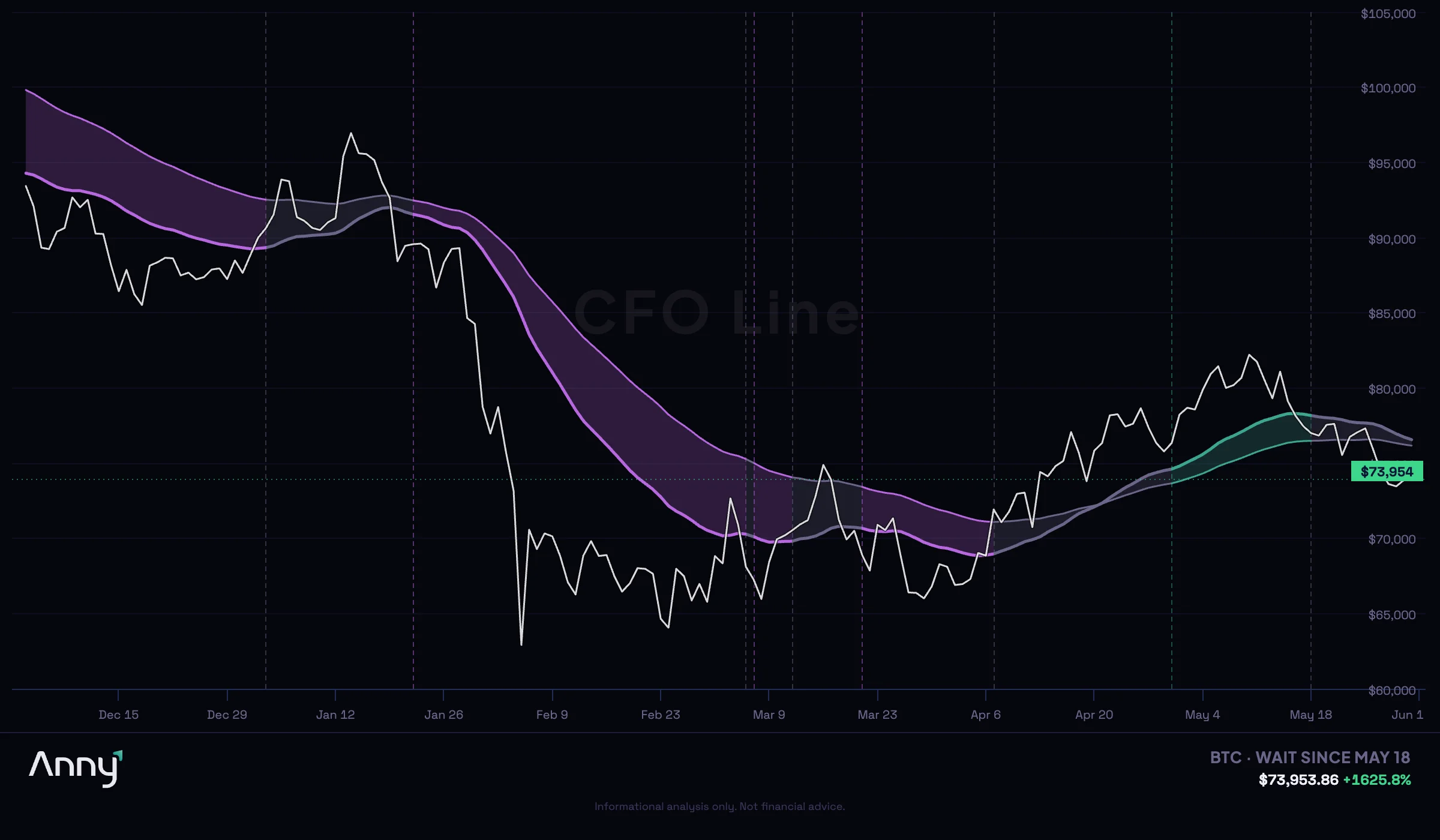
Check the CFO Line to see what capital flow regime your assets are in right now.
Disclosure: the CFO Line is Anny's own regime indicator and has no third-party validation — weigh it as you would any proprietary tool. This analysis is for educational purposes only — not financial advice. Past performance does not indicate future results. Anny is an AI-powered analytics platform, not a registered investment adviser. Crypto assets are volatile and you can lose your entire investment.
Want Anny's AI to analyze your portfolio? Try the Anny Line or see pricing.