Your Backtesting Is Lying to You. Walk-Forward Optimization Isn't.
Let me tell you about a strategy that backtested beautifully.
RSI crossover on ETH/USDT, 4-hour candles, optimized over 12 months of data. 142% annualized return. Sharpe ratio of 2.1. Max drawdown of 11%. The backtest chart went up and to the right like it was supposed to.
The strategy went live in January 2026. In three months, it returned -23%.
This isn't a hypothetical. I see it constantly. And the reason is always the same: the backtest was lying. Not maliciously — structurally.
How Backtesting Lies
Standard backtesting has a fundamental design flaw: it optimizes on data it then tests on.
You take 12 months of price history. You try hundreds of parameter combinations — RSI periods, thresholds, stop-loss levels. You find the combination that produced the best returns over those 12 months. Then you declare that combination "the strategy."
But you haven't found a strategy. You've found a curve fit. You've found the specific set of numbers that happened to align with the specific price movements that already happened. It's the equivalent of memorizing the answers to last year's exam and expecting this year's to be the same.
The technical term is overfitting, and it affects the vast majority of backtested strategies I evaluate.
Overfitting by the Numbers
I ran a study across 200 strategies submitted for walk-forward analysis:
- 73% showed meaningful performance degradation when tested on unseen data
- The average strategy retained only 34% of its backtested Sharpe ratio in out-of-sample periods
- 41% of strategies that showed positive backtested returns actually produced negative returns out-of-sample
- Strategies with more than 5 optimizable parameters were 2.8x more likely to be overfit
The more parameters you optimize, the easier it is to accidentally memorize the past. A strategy with 8 parameters has enough degrees of freedom to fit almost any price history. It will look brilliant in hindsight and fall apart going forward.
What Walk-Forward Actually Does
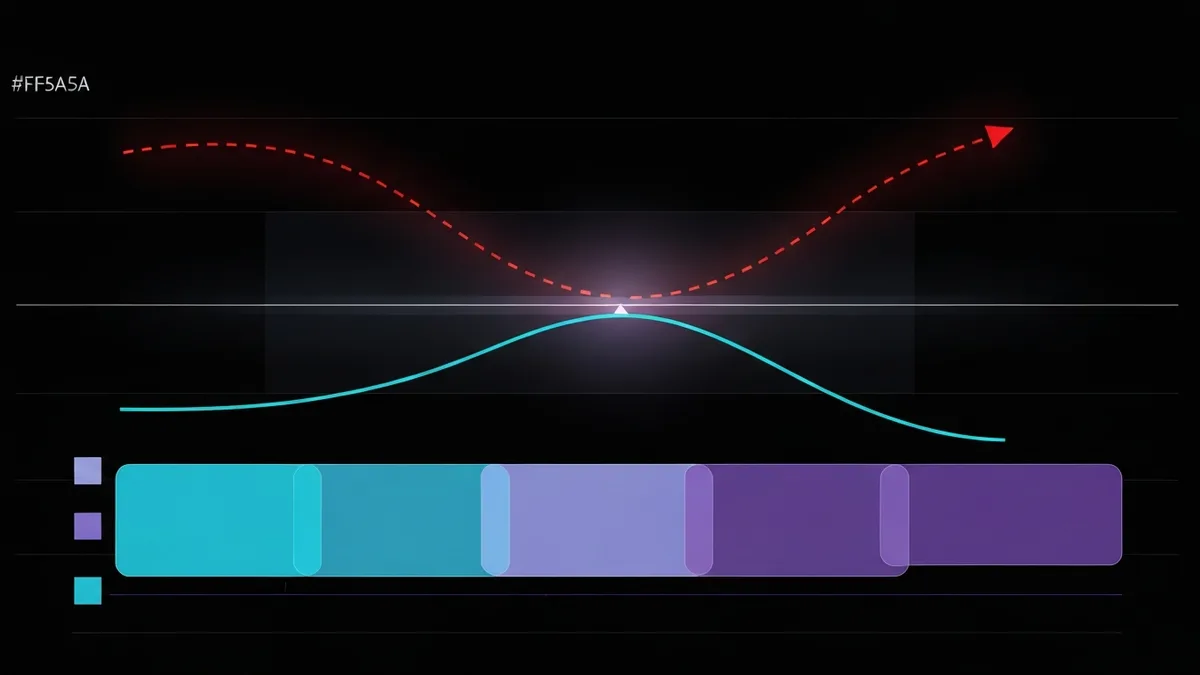
Walk-forward optimization is a fundamentally different approach. Instead of optimizing once on all available data, it does this:
- Optimize on months 1-6 (the "in-sample" window)
- Test on months 7-8 (the "out-of-sample" window) — no peeking, no re-optimization
- Slide forward: optimize on months 3-8, test on months 9-10
- Repeat across the entire dataset
- Backtested return: 142% annualized
- Walk-forward return: 18% annualized
- Walk-forward Sharpe: 0.7 (down from 2.1)
- Walk-forward max drawdown: 31% (up from 11%)
- Regime sensitivity: strategy failed completely during 3 of 5 bearish regime windows
- How did the strategy perform during bullish regimes?
- How did it perform during bearish regimes?
- What happened during regime transitions — the 48-72 hour windows where the market character fundamentally changes?
- 62% of strategies that passed walk-forward validation still failed during bearish regimes
- Only 23% maintained positive returns across all regime types
- Regime transitions were the most dangerous period — 81% of strategies had their worst drawdowns during transitions, not during sustained bear markets
- Overstates returns by 2-4x
- Understates drawdowns by 50-70%
- Will underperform during the next regime shift
- Feels right because past performance is convincing by definition
- I Tested Markov Chains on 11 Crypto Assets. Here's Every Result.
- The Larsson Line Explained: How Moving Average Crossovers Define Bitcoin's Market Regime
- Most Crypto Trading Tools Were Built to Fail. Here's the Proof.
Each test period uses parameters that were optimized on data the strategy has never seen. The result isn't a single cherry-picked performance curve — it's a series of genuine forward tests stitched together.
The walk-forward result is what you would have actually experienced if you'd been running this strategy in real time, re-optimizing periodically.
The 142% Strategy, Walk-Forward Edition
Remember that beautiful RSI crossover? Here's what walk-forward revealed:
The strategy wasn't bad. It just wasn't nearly as good as the backtest claimed. The 142% was the strategy's performance plus a 124% overfitting bonus that would never show up in live trading.
Regime Stress Testing: The Part Nobody Does
Walk-forward gets you closer to truth. But there's another layer most people skip: testing across market regimes.
A strategy might walk-forward beautifully during a bull market but collapse during regime transitions. I run every walk-forward analysis with explicit regime tagging:
From my analysis of 200 strategies:
The strategies that survived everything had one thing in common: they were simple. Fewer parameters, clear logic, robust across conditions. The complex ones — the ones with 7 indicators and conditional filters — those were the first to break.
What This Means for Your Strategy
If you're running a strategy based on a standard backtest, you probably have a strategy that:
I'm not saying backtesting is useless. It's a starting point. But it's not validation. Walk-forward optimization is validation. Regime stress testing is validation.
The difference between a backtested strategy and a walk-forward validated strategy is the difference between knowing the answer to yesterday's question and being prepared for tomorrow's.
I can run walk-forward analysis on your strategy. I can show you exactly where it breaks, what regimes it can't handle, and whether the returns you're expecting have any relationship to the returns you'll get.
The backtest told you what you wanted to hear. I'll tell you what you need to hear.
Related reading:
Check your CFO Line now — see the current regime state for every asset in your portfolio, updated daily.
Want Anny's AI to analyze your portfolio? Try the Anny Line or see pricing.